
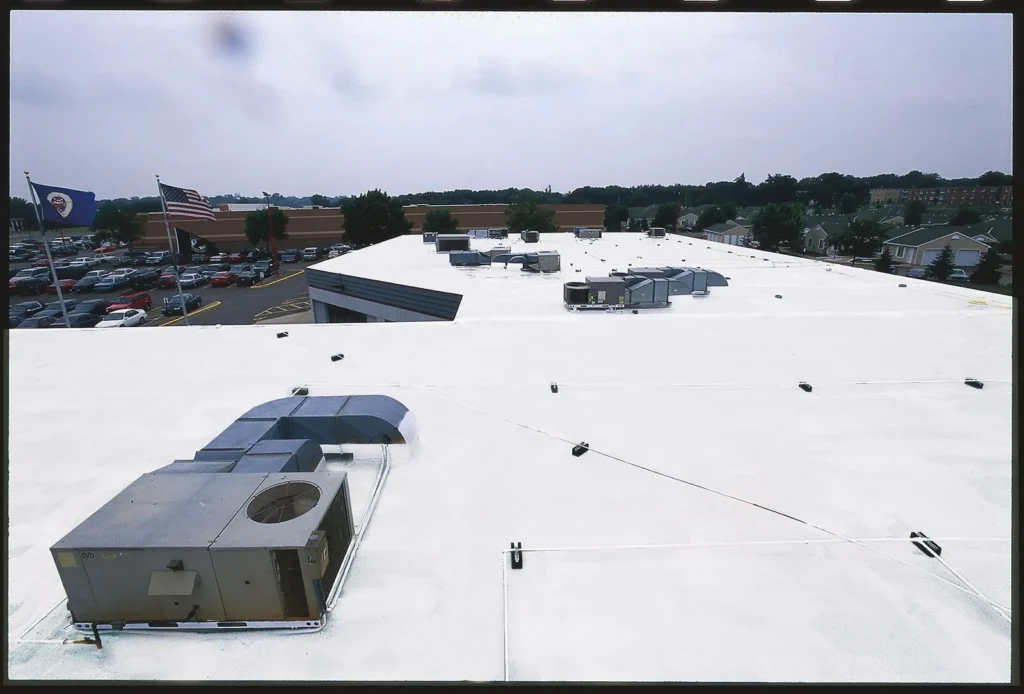
When a commercial roof starts leaking, the first quote many owners receive is for a full replacement. Sometimes that is the right answer. Often it is not. For manufacturing plants, distribution buildings and downtown commercial buildings in Chambersburg and across Franklin County, there are three real options: repair, restore or replace. Knowing the difference can save a building owner a large share of the cost of a new roof.
Option 1: Repair
A repair fixes a specific problem on a roof that is otherwise in good condition. Typical examples are an open seam on a single-ply membrane, cracked flashing at a wall, a failed boot around a pipe, or a small area damaged by a fallen branch or foot traffic.
Repair makes sense when:
- The leak is isolated and the rest of the roof is sound.
- The membrane is still flexible and well attached.
- There is little or no wet insulation below the problem area.
Repairs are the fastest and least expensive fix, but they do not extend the life of the whole roof. If a roof needs a new repair every few months, it is telling you something bigger is going on. Read more on our roof repair service page.
Option 2: Restore
Restoration renews the entire roof surface without tearing it off. The roof is cleaned, damaged areas and wet insulation are repaired or replaced, seams and penetrations are reinforced, and a seamless coating system is applied over the whole surface. Depending on the roof, that can be a membrane roof coating, a fabric reinforced system or, on metal buildings, a full metal roof restoration.
Restoration makes sense when:
- The roof is aging and leaking in several places, but the deck is structurally sound.
- Most of the insulation is dry.
- You want to avoid the disruption, noise and disposal costs of a tear-off.
For food processing and manufacturing buildings, restoration has another advantage: the work can usually be scheduled around production, because nothing is opened up to the weather. Reflective white coatings can also lower rooftop temperatures in summer, which helps buildings with heavy cooling loads.
Option 3: Replace
Replacement means removing the existing roof down to the deck, or adding a new system over it where codes and conditions allow, and installing a new roof. It is the most expensive option and the most disruptive, but sometimes it is the only responsible one.
Replacement makes sense when:
- Large areas of insulation are saturated.
- The deck is rusted, rotted or damaged.
- The building already has two roofs on it, which is the usual limit.
- The use of the building has changed and the roof system no longer suits it.
When replacement is needed, choosing the right system matters. PVC single-ply membranes, for example, resist grease and many chemicals, which makes them a strong choice around exhaust on food processing and restaurant buildings. Our single ply roofing and commercial roof installation pages cover the options.
How to Know Which Option Your Roof Needs
You cannot tell from the ground. The answer depends on what is happening under the membrane, especially how much water the insulation has absorbed. A proper commercial roof inspection checks the surface, seams, flashing and drains, and looks for moisture across the roof before anyone recommends a solution.
Chambersburg’s mix of older downtown buildings, plants and newer distribution space along I-81 means roofs in the area are at every stage of life. Learn more about the buildings we see in the area on our Chambersburg commercial roofing page.
Get a Straight Answer About Your Roof
Double H Commercial Roofing works with building owners and property managers in Chambersburg and across Central Pennsylvania. Every evaluation is free, photo-documented and comes with honest options. Call 814-380-8978 (Monday to Friday, 8 AM to 8 PM) or request your free roof evaluation.