
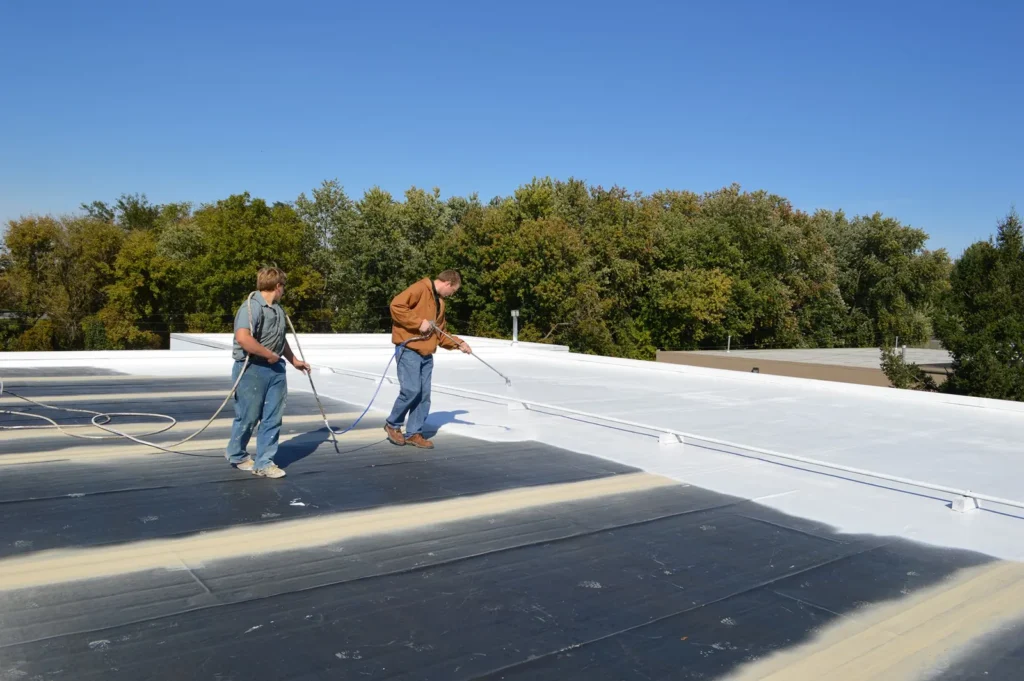
Shippensburg sits on the I-81 corridor between Chambersburg and Carlisle, with the university, a historic downtown and a growing number of warehouse and light industrial buildings nearby. Many of those buildings have low-slope roofs that are starting to show their age. For a lot of them, a roof coating is the most cost-effective way to stop leaks and add years of service. For some, it is the wrong answer.
Here is how to tell which group your building is in.
What a Commercial Roof Coating Actually Is
A roof coating is a liquid-applied system, usually acrylic, silicone or a similar elastomeric product, that cures into a seamless, flexible membrane over the existing roof. Done properly, it is not a coat of paint. The roof is cleaned, repaired and primed first, seams and penetrations are reinforced, and the coating is applied at a specified thickness so it can carry a manufacturer’s warranty.
Coatings can be applied over most common commercial roofs, including single-ply membranes like TPO and EPDM, modified bitumen, built-up roofs, spray foam and metal. See our membrane roof coating and metal roof restoration pages for how the systems differ.
Signs Your Building Is a Good Candidate
- The roof leaks in a few places, but the deck is solid.
- Most of the insulation is dry when checked for moisture.
- Seams are opening or the membrane surface is chalking, cracking or shrinking.
- A metal roof has loose fasteners and surface rust, but the panels are still structurally sound.
- You want to avoid the noise, mess and disruption of a tear-off.
When a Coating Is the Wrong Choice
A coating cannot fix a roof that has failed underneath. If large areas of insulation are saturated, if the deck is damaged, or if water ponds deeply for days after rain because of structural sagging, coating over those problems only hides them. An honest contractor will tell you when a replacement is the better investment.
How the Process Works
- Evaluation. The roof is inspected, photographed and checked for moisture.
- Cleaning. The surface is power washed so the coating bonds properly.
- Repairs. Wet insulation, damaged membrane and failed flashing are replaced.
- Reinforcement. Seams, fasteners and penetrations are sealed and reinforced, often with fabric embedded in the coating. Learn more about fabric reinforced roofing.
- Coating. The system is applied at the thickness the manufacturer requires.
- Final inspection. The finished roof is walked and documented.
The Benefits Owners Notice
The first benefit is simple: the leaks stop. Beyond that, a bright white coating reflects sunlight, which keeps the roof surface and the space below it cooler in summer. Because the old roof stays in place, there is no tear-off debris to haul away and far less disruption to tenants and operations. And because a coating system can often be renewed at the end of its life, the roof never has to go back to square one.
As a Conklin Roofing Systems distributor, Double H installs coating systems designed for exactly this kind of work. Buildings in nearby Carlisle and Chambersburg face the same weather and the same aging roof stock, so the same questions apply there.
Get a Straight Answer About Your Roof
Double H Commercial Roofing works with building owners and property managers in Shippensburg and across Central Pennsylvania. Every evaluation is free, photo-documented and comes with honest options. Call 814-380-8978 (Monday to Friday, 8 AM to 8 PM) or request your free roof evaluation.